

I was trading LinkedIn messages with a Senior Director at a major iPaaS player. I asked him a blunt question: “If I was trying to advance my career today, what’s the one thing you’d learn to stay ahead of the curve?”
He didn’t mention the usual suspects like Python or specific vendor certifications. Instead, he stated two protocols that are quietly becoming the “load-bearing walls” of the next era of integration.
The industry is moving away from “Data Moving” and toward “Intelligence Orchestration.” If you want to start landing iPaaS contracts, you need to understand how the plumbing of AI is actually being built.
The two protocols he identified are MCP (Model Context Protocol) and A2A (Agent-to-Agent). If you’ve looked at enterprise integration contracts in the last three months, you’ve likely seen phrases like “Contextual Data Access” or “Agentic Orchestration.” These are the technical standards making those requirements possible.
1. Model Context Protocol (MCP): Meeting the “Context” Demand
Enterprise clients are no longer asking for simple syncs; they are asking how to make their internal data “AI-ready.”
MCP is the universal standard (pioneered by Anthropic and adopted by Google) that solves this. Instead of you writing a unique connector for every app, you build an MCP Server.
Landing the Contract: When a client asks for “AI-Ready Data Architecture,” you pitch an MCP-first approach. It’s the “USB-C” of AI, and it prevents the vendor lock-in that clients are terrified of.
Selling the Client: Use MCP to show them how their AI (Claude, Gemini, etc.) can “see” their legacy SQL databases or Salesforce records in real-time without fragile, custom-coded pipes.
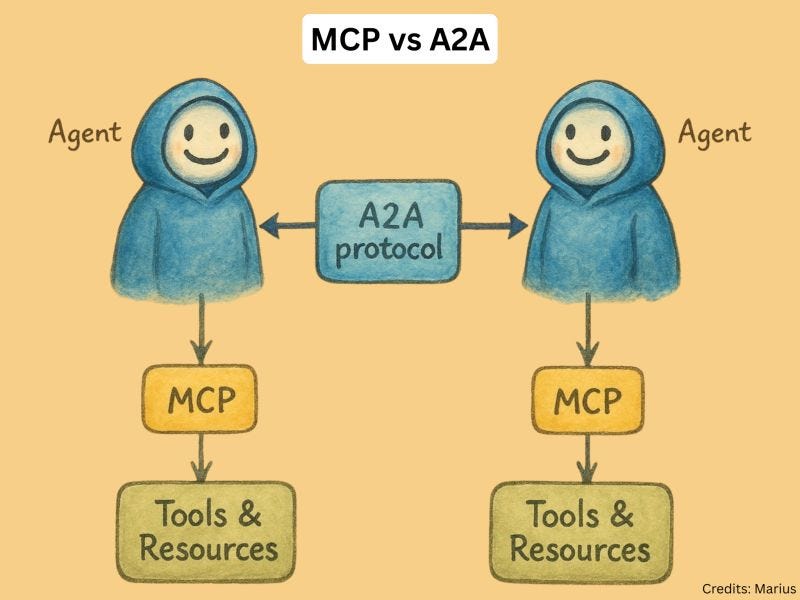
2. Agent-to-Agent (A2A): Winning the “Agentic” RFP
The “Linear Workflow” is dying. High-value contracts are now asking for “Horizontal Orchestration”—where an “Invoicing Agent” can autonomously talk to a “Collections Agent.”
A2A is the protocol that governs how these agents discover each other and negotiate tasks.
Landing the Contract: If you see an RFP mentioning “Agentic Workflows” or “Multi-Agent Systems,” you are looking for A2A.
Selling the Client: Instead of selling them on your experience building integration flows, sell them an Agentic Ecosystem. You aren’t just building a flow; you’re building the governance layer that allows their AI agents to work together without breaking the system.
Your 24-Hour Masterclass
You don’t need a new degree; you need proof that you can fulfill these specific requirements.
The “Hello World”: Build a basic MCP Server using Python or TypeScript. Use it to connect an AI to a “messy” data source like a local CSV or a private Slack channel.
Study the “Agent Card”: This is the DNA of A2A. Learn how agents “introduce” themselves to each other.
The Resource Stack:
Workato Enterprise MCP: This is the fastest way to bridge the gap between enterprise-grade security and AI context. It allows you to expose your existing Workato recipes as secure MCP tools for LLMs.
MuleSoft AI Chain: Use this to explore how to wrap your existing MuleSoft APIs into agentic frameworks, ensuring your legacy integrations are ready for an A2A ecosystem.
Anthropic’s MCP Documentation: This is the primary “source of truth” for the protocol and essential for understanding how to build custom MCP servers from scratch.
Google Cloud Codelabs: Look specifically for the “Agentic Networking” and “Vertex AI Agent Builder” modules to see how A2A is being deployed at scale in enterprise environments.
How to Get Recruiters Chasing You
Recruiters are currently “keyword hunting” for the very few people who understand these protocols. To get to the top of the pile:
Update Your Headline: Change it to “AI Integration Architect | Specialist in MCP & A2A Orchestration.”
The “Governance” Hook: Mention in your bio that you specialize in “Agent Discovery & Protocol Governance.” This signals that you understand the architecture, not just the tools.
The Proof of Work: Post a short video of an AI agent using an MCP server you built. When a recruiter or client sees that you can bridge the gap between “Raw Data” and “AI Context,” you move from “Integration Person” to “AI Automation Architect.”
The Bottom Line: You don’t have to “convince” clients this is the future, because the market is already asking for it. If you can speak the language of MCP and A2A, you’re no longer competing on price; you’re competing on the fact that you’re the only one who knows how to build the engine.