

Change is hard.
For years, MuleSoft was the undisputed king of enterprise integration. But after building on both, the "vCore" era is starting to feel like a legacy burden. Here’s why Workato is winning the race for modern automation.
1. Intelligence over manual effort
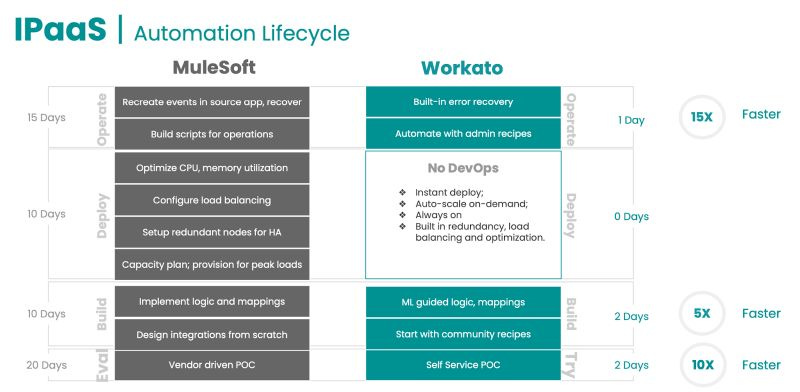
While MuleSoft requires deep DataWeave expertise, Workato uses ML-guided logic. It suggests mappings based on millions of successful community recipes, turning hours of coding into minutes of clicking.
2. A "GitHub" for Integrations
Workato’s community library is massive. Instead of official templates only, you get access to a living ecosystem of reusable recipes. If a workflow exists, someone has likely already built it and shared it.
3. Zero-Footprint Development
MuleSoft still tethers you to Anypoint Studio (desktop IDE) for heavy lifting. Workato is 100% cloud-native. Develop, test, and deploy from any browser—no local installs, no version mismatches.
4. Faster Speed to Connection
Establishing a handshake with giants like Salesforce and NetSuite is remarkably frictionless in Workato. It treats these systems as first-class citizens, whereas MuleSoft often feels like it’s building the plumbing from scratch every time.
5. Invisible Infrastructure
Stop worrying about worker sizes and vCore allocation. Workato is serverless and elastic. It handles auto-scaling and load balancing natively, so you focus on business logic, not infrastructure management.
6. Plug-and-Play Observability
Streaming logs to Splunk or AWS is a native, clicks-not-code experience in Workato. In the MuleSoft world, this often involves wrestling with log4j configurations or expensive “Titanium” tier upgrades.
As I continue to develop on both platforms, I'm sure I'll be discovering more advantages.